
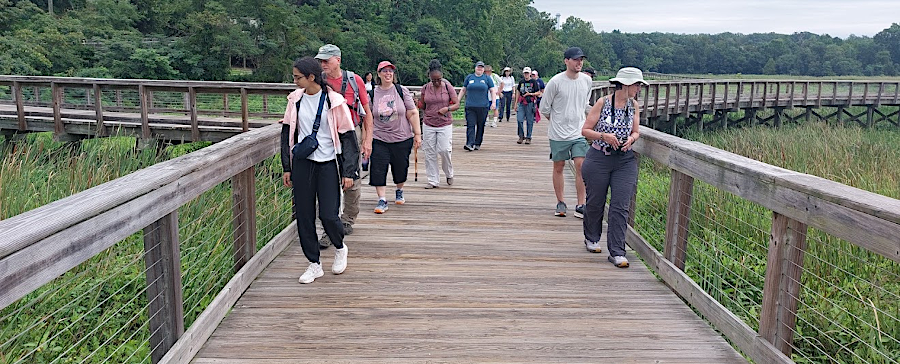

For years, Manassas and Manassas Park have been steadily funding and building trails included within their transportation plans and annual budgets.
Manassas Park has converted the golf cart paths in Blooms Park into a trail network through the woods. Sidewalks throughout the city provide connections between neighborhoods and the new town center, Park Central.
Manassas Park now seeks to build a new pedestrian bridge across Route 28. Linking the east and west sides of the city would enable Safe Routes to School. The city also has the opportunity to construct a trail linking Signal Bay Waterpark to Splashdown WaterPark. Much of the route would follow a UOSA pipeline, with small portions passing through the City of Manassas and Prince William County.
Manassas completed most of its planned bike/pedestrian network by 2026. That city now has lead responsibility for the $30 million Rail-With-Trail Project to construct a trail between the train station in downtown Manassas and the Bull Run-Occoquan Trail in Fairfax County, including a new bridge over Bull Run. The trail will pass through Prince William County and Manassas Park, where it will connect with the train station there and then go through Blooms Park.
Major trails still remaining to be completed in Manassas are:
Godwin Trail (North)
Redoubt Road Trail
The “opportunity” now is for Prince William County to build nearly 300 miles of officially-planned new trail segments.
Prince William County took a major step forward when the Board of County Supervisors adopted a 10-year Trail Master Plan, Pathways 2025, on October 20, 2026. That plan identified specific trail segments for “Recreational” and “Active Mobility” trails, adding more detail to the trail plan adopted by the supervisors in 2022 with approval of the Mobility Chapter in the 2040 Comprehensive Plan.
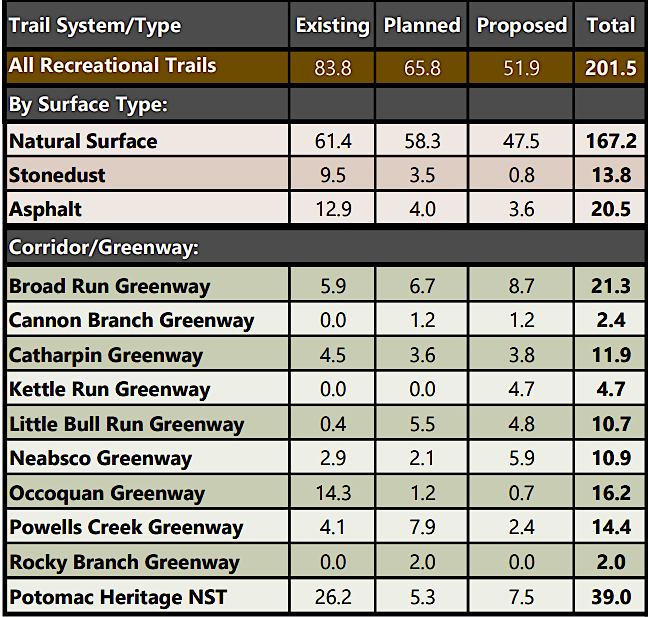
The county has a thin track record for constructing new trails. Almost all of the Occoquan Greenway, and the mountain biking trail networks in Locust Shade, Andrew Leitch, and James Long parks, were completed by volunteers. The Neabsco Boardwalk, and more-recent completion of segments of the Potomac Heritage National Scenic Trail (PHNST) between Belmont Bay-Veterans Park and through Featherstone National Wildlife Refuge, demonstrate that county staff have the capacity to successfully complete trails when funding is provided.
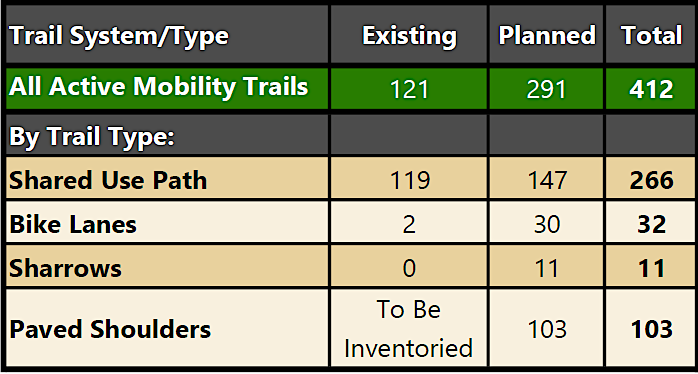
Pathways 2035 identified 291 miles of new active mobility trail segments (paved, suitable for street bikes and strollers/wheelchairs on shared use paths) and 118 miles of new recreational trail segments (natural surface/gravel, suitable for walking).
Those segments, when built, will establish a complete bike/pedestrian network in Prince William County.
Specific Trails to Build
Most new active mobility trail segments are associated with road projects to be completed by the Department of Transportation and Capital Construction (DTCC) and the Virginia Department of Transportation (VDOT). New bike lanes and paved shoulders will be added when existing roads are widened or repaved by VDOT. Sharrows can be added by restriping some roads with low speed limits, potentially creating shared streets.
Government agencies often distinguish “sidewalks” from “trails,” but people going from one place to another pay no attention to how a path is classified. In Prince William County, DTCC is constructing a number of new sidewalks to close gaps in the existing bike/pedestrian network.
Some new shared use paths are planned separately from projects to construct new roads and convert existing at-grade intersections into grade-separated interchanges:
Flat Branch Trail (to be added)
Jefferson Park/Veterans Park Connector Trail (to be added)
North Woodbridge Pedestrian Bridge (to be added)
Route 234 Trail at Innovation Park
Sudley Manor Drive Sidewalk (to be added)
See also: The Pathways 2035 Trails Plan Needs to Be Funded to Become “Real”