From Planning to Funding to Building to Maintaining –
Creating a Comprehensive Network of Public Trails is Challenging
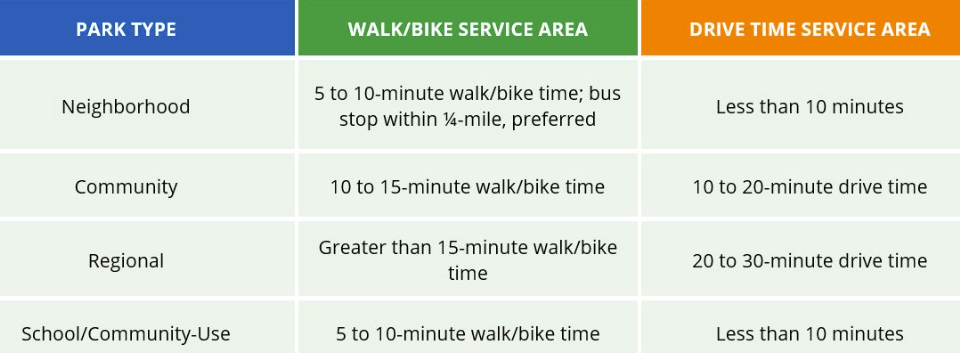
The Strategic Plan and the 2040 Comprehensive Plan in Prince William County emphasize creation of live-work-play walkable communities. The county’s Level of Service Standard (above) is for neighborhoods to be within a 15-minute walk of a community park.
The “opportunity” is to make that planning become reality. The county has planned trails since 1993, but elected officials have rarely provided funding to actually build what was planned.
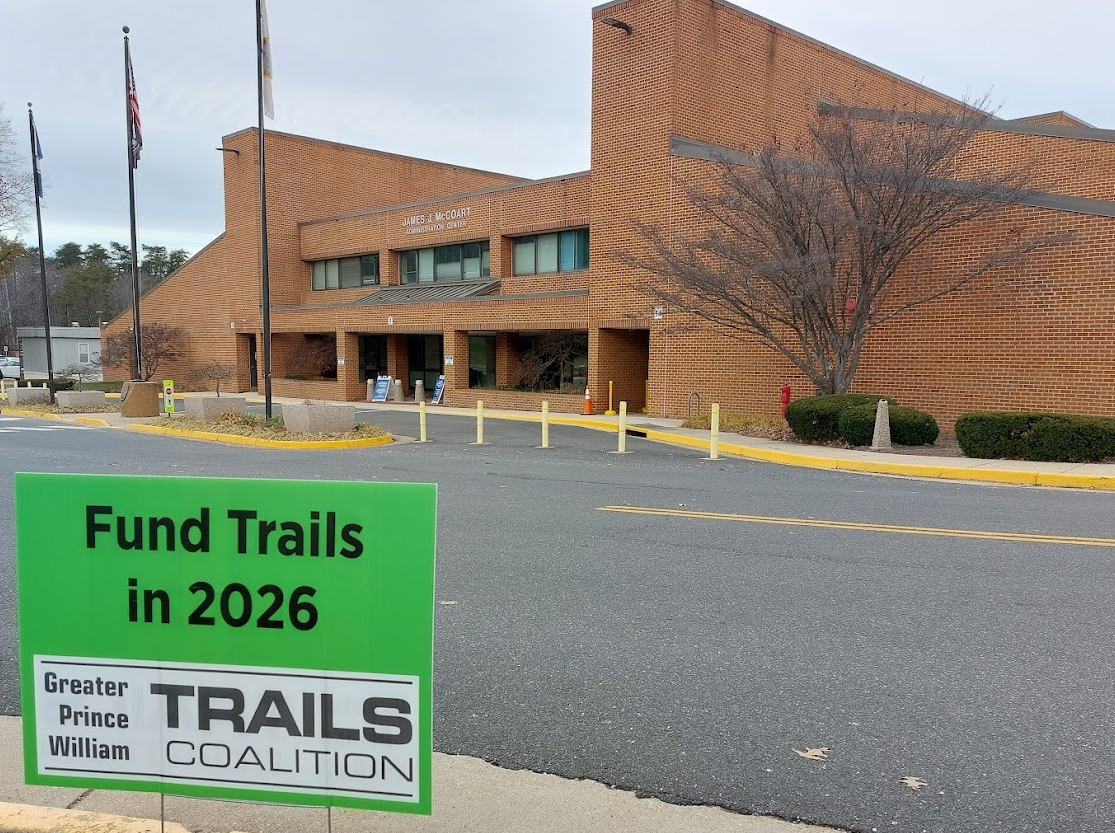
In 2026, trail advocates are encouraging the Board of County Supervisors in Prince William County to dedicate sufficient funding to convert trails planned on a map into trails actually completed on the ground. The “ask” is to increase the $1 million/year added to the General Fund in 2025 to $5 million/year, and to authorize voters on November 3 to approve a $300 million bond issue to build a significant chunk of the planned trails. Alternative funding methods are also a possibility… but without new funding, new trails won’t be built.
Those who want to see trails built (rather than just envisioned) can contact the eight elected supervisors at bocs@pwcgov.org and express support for the substantial funding required to build the roughly 100 miles of planned new recreational trails and 200 miles of active mobilty trails (primarily paved Shared Use Paths).
Background
There are segments of natural surface trails on already-public land that are low-cost, “low hanging fruit” opportunities where volunteers can do much of the work. However, many planned segments require expensive bridges and land acquisition. Closing gaps in sidewalks can cost $15 million/mile. Building the bike/pedestrian compoment of the Prince William County mobility plan. Like roads, trails are not free.
The Manassas Capital Improvement Program (CIP) and the Manassas Park CIP have provided the funding needed to complete planned trail projects Today, there are just a few projects remaining to complete the planned bike/pedestrian networks in those two cities.
The story is different in Prince William County. Since the arrival of the Shirley Highway (now I-95) at the Occoquan River 75 years ago, county officials focused on building new roads. Trails were an afterthought, at best.
Volunteers, particularly the Prince William Trails and Streams Coalition and the Mid-Atlantic Off-Road Enthusiasts (MORE), built most of the trails within county parks. Developers proffered isolated trail segments, grants funded a few stretches, and Paved Shared Use Paths were added as roads were expanded.
The Mobility Chapter of the 2040 Comprehensive Plan, approved in 2022, was a solid start for identifying how to link the pieces into a bike/pedestrian network with the ability to get places without a car comparable to the fully-planned roadway system. That chapter included 15 pages of trail projects, but details were vague. The Countywide Trails Plan map did not specify which side of a stream would be used in some major greenways. There were no cost estimates, unlike the Roadway Plan with $7 billion of costs for its 15 pages of specific proposed projects.
The organizations which belong to the Greater Prince William Trails Coalition spent five years identifying ways to create a solid network. The Department of Parks and Recreation, with assistance from the Prince William Transportation Department, is now completing a more-detailed Trails Master Plan. The “where to build trails” question is about to be answered, with approval of the 2026 Trails Master Plan anticipated in May.
It will include specific cost estimates for each proposed trail segment. By defining the routes which can use county-owned land and easements with greater clarity, costs can be guesstimated for acquiring the property rights and constructing over 300 miles of trail needed to link now-fragmented segments into a comprehensive network of public trails.