Prince William County revenue has increased dramatically with the addition of revenue from data centers. New data centers have been completed and become operational in the last year. As a result, in January-April 2027 the eight elected county supervisors will have the pleasant task of appropriating additional $$$ in the FY28 budget.
In the FY27 budget, much of that new tax revenue was used to increase the number of county employees (FTE) and to raise salaries. However, repeating that approach in FY28 involves a significant financial risk that could end up threatening the county’s AAA bond rating.
Revenue from data centers may be a short-term phenomenon. The taxes come primarily from the computer servers and other equipment installed within the buildings. As technology evolves, the need for all of that hardware is Prince William County may diminish. A particular risk: Space X plans to create a system of orbital data centers, using space for solar energy and cooling, that could replace the ground-based data centers as well as stop construction of new ones.
If computer hardware is depreciated and not replaced with new chips, the rapid rise in county tax revenue from data centers may reverse dramatically in the 2030’s. The massive concrete shells may not become empty buildings or be converted into indoor farming operations right away, but tax revenue from the land/buildings is small compared to the revenue from equipment inside.
How can the county supervisors minimize the risk that budget increases approved in the late 2020’s will become unsustainable with diminished tax revenue in the 2030’s?
A logical approach to utilizing a short-term tax revenue “bump” is to fund items in the Capital Improvement Plan (CIP). Unlike FTE, items in the capital program (such as new buildings to expand the courthouse or major restorations of existing facilities) are primarily one-time expenses. Investing in parkland and constructing trails would be a wise use of what may be a temporary revenue source.
Some capital items can create long-term operational costs. New libraries and indoor recreation centers are one-time capital projects, but such facilities require new staff for offering programs and for annual operations/maintenance of the structures.
The risk of burdening future residents with perpetual costs might be mitigated by creating revenue-generating programs at such facilities, such as private-public partnerships where groups pay rent to use a county-owned building. Like any business, however, such partnerships require staff to offer activities that attract enough customers to cover some/all of the annual costs over the years.
Funding the trails planned in Pathways 2035 would create minimal future operational costs. Once segments are built, the FTE required to patrol and maintain a trail system is minimal. Long-term trail maintenance costs are certainly not zero, but clearing trees downed by storms and replacing bridges every 30 years is far less expensive than dealing with plumbing and HVAC systems of buildings.
Pathways 2035 prioritized construction in three categories. The highest priority, Tier 1, includes 54.38 miles of recreational trail segments. Constructing them was estimated in 2026 to cost $68-$326 million. The 76.12 miles of Tier 1 active mobility trails were estimated to cost $456 -$608 million to complete.
Overall, building all the segments planned in Pathways 2035 was projected to cost about $1 billion. Sound like a lot of money?
To put that number into context:
– the cost to complete the bike/pedestrian network estimate is 15% of the projected cost in the 2022 Mobility Chapter for additional paved highway “lanemiles” and interchanges. Roughly $7 billion is proposed to build additions to the existing road network, expanding even further the highway system that has been funded since the Shirley Highway was built from the Pentagon to the Occoquan River in 1949.
– the Countywide Space Study (see Item 6D) estimates $1 billion is needed to construct new office buildings for county employees at the McCoart Administrative Center.
The Prince William Board of County Supervisors relied upon grants, proffers, and intermittent appropriations to fund trails until 2024. In the FY25 budget, the supervisors started to appropriate $1 million annually to build new trails. The Department of Transportation and Capital Construction plans to use that funding for just one trail project each year.
There are six ways to fund the trails planned in Pathways 2035, in order to provide $25 million/year in annual funding plus a one-time infusion of $300 million via a voter-approved bond issue:
Annual General Fund Appropriations
Steady county funding, starting with the FY28 budget, could fund the design and land acquisition required to create site-specific plans for trail routes. Maps developed with the Pathways 2035 plan do not include all details, such as the exact locations where bridges will be constructed.
Funding is needed for staff and contractors to negotiate with willing landowners for permission to build trails across private property. Much of the planned network of trails crosses through the common property of Home Owner Associations (HOAs) and where utilities such as Dominion Power hold easements. Such negotiations require time for establishing trusted relationships between landowners and the county agencies who will build/maintain trails, then completing surveys and signing deeds.
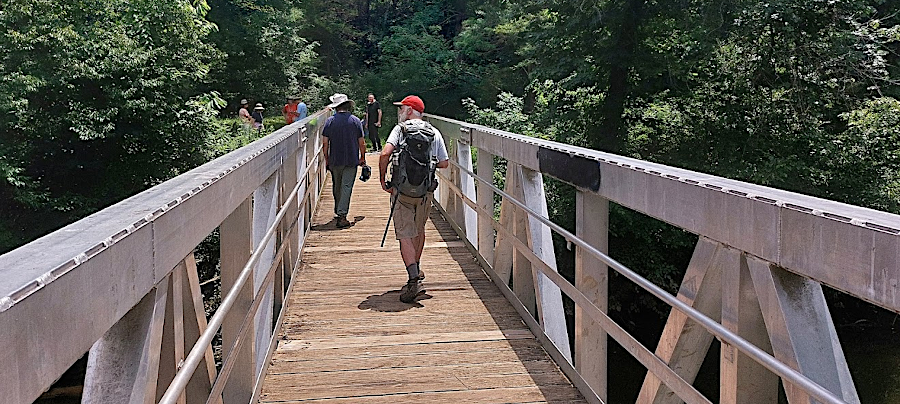
Annual funding is particularly useful for completing recreational trail segments within county parks and greenways. New trails require clearing vegetation, placing gravel, constructing bridges, and installing wayfinding signs. The Department of Parks and Recreation, with staff dedicated to trail construction and assistance from volunteers, has the potential to complete
2027 Bond Issue
Bonds are a mechanism to spread the costs of capital improvements over 20 years. Since future residents will receive the benefits of those improvements, it makes sense for future taxes to cover the costs. The county maintains a AAA rating for its bonds by staying within a debt limit and maintaining a reserve fund. As old bonds are paid off, capacity becomes available for selling new bonds.
County supervisors have authorized road bonds in 1988, 1990, 1994, 1998, 2002, and 2006. Most recently, in 2019 voters approved $355 million in bonds for road projects and $41 million for parks and trails. The 2019 parks/trails bond received 65% voter approval.
A 2006 parks bond for $27 million included just $750,000 for trails. That bond received approval by over 75% of the voters.
Why ask for Prince William County voters to approve a bond for constructing trails in 2027?
The need for trails is clear, and the supervisors approved a specific plan for where to build new trails in October 2026. The cost to expand bike/pedestrian infrastructure should be spread over the next 20 years, rather than funded completely by tax revenue collected in just one year. The county can schedule issuing new bonds in the FY28, so it stays within debt capacity limits and replenishes the reserve fund enough to preserve the AAA bond rating.
In 2027, the Virginia General Assembly may authorize a statewide parks, trails and open space bond issue for voters to approve in November. The last such bond was approved in 2002. It is always challenging to ask voters to approve government funding, but would be timely to organize a “vote green – statewide and locally” campaign in 2027.
Volunteer Contributions
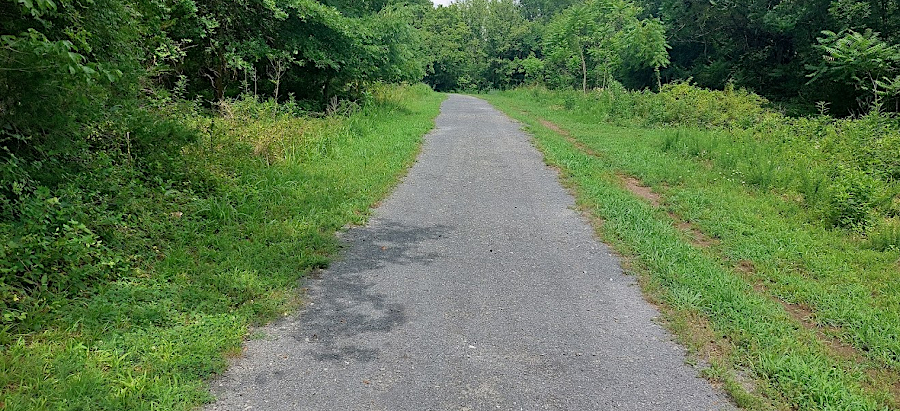
Prince William Trails and Streams, Mid-Atlantic Off-Road Enthusiasts (MORE), and other non-government organizations have been constructing and maintaining trails for years within county greenways and parks.
Almost all of the Occoquan Greenway was built by volunteers. The mountain bike networks in Locust Shade Park and James Long Regional Park were designed and constructed by the mountain bikers. The equestrian trails in Manassas National Battlefield Park were created by the Battlefield Equestrian Society, and volunteers organized by the Prince William Conservation Alliance produced the trails in Merrimac Farm Wildlife Management Area.
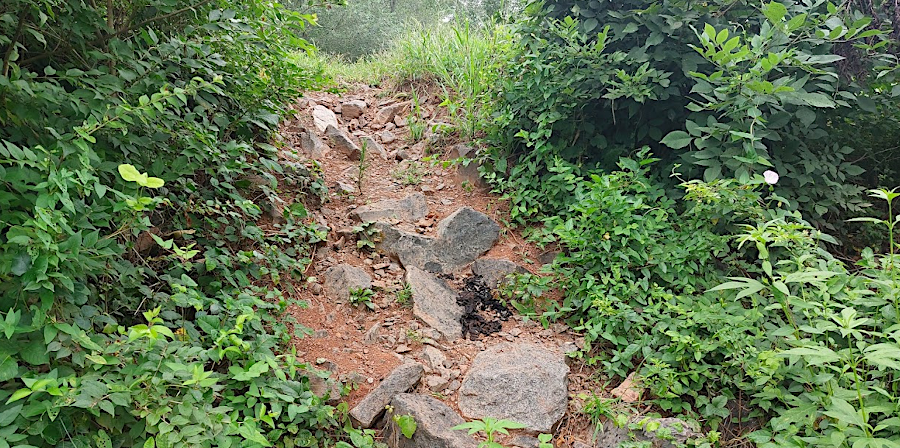
Pathways 2035 identified 61 miles of “low hanging fruit” trails which require no land acquisition, expensive bridges, or heavy construction equipment. There are such segments in each magisterial district:
Brentsville – 24 segments, 17.88 miles
Coles – 8 segments, 5.21 miles
Gainesville – 23 segments, 18.65 miles
Neabsco – 9 segments, 3.23 miles
Occoquan – 1 segment, 1.21 miles
Potomac – 15 segments, 13.51 miles
Woodbridge – 4 segments, 1.62 miles
The county’s Department of Parks and Recreation now welcomes volunteer initiatives to construct new trail segments for which the county will accept maintenance responsibility. That change in policy was made in 2026. Previously, the county agency had authorized volunteers to build only new trails which the volunteers also committed to maintain.
The Trails and Blueways Council is prioritizing the low hanging fruit projects. The Greater Prince William Trails Coalition is preparing to recruit the volunteers needed to build those trail segments, with the goal of completing them by the end of 2030. Community support, including donations of material such as lumber and gravel, will determine how fast the volunteers can complete the low hanging fruit segments.
Grants
The county’s Department of Transportation and Capital Construction (DTCC) and the Department of Parks and Recreation (DPR) can apply for grants available from regional, state, and Federal agencies.
Winning a grant is like painting a room in a house – 90% of the work is in the initial preparation, such as placing tape around the edges of windows. County agencies need sufficient staff to complete plans and designs, and to acquire rights-of-way, in order to prepare applications likely to receive funding in the competitive processes.
Some grants can be substantial. In 2026, the Northern Virginia Transportation Authority (NVTA) awarded a $30 million grant for the VRE Manassas Line Trail: Landmark to City of Manassas project jointly submitted by Manassas, Manassas Park, and Prince William County. That will fund a bike path stretching from the train station in downtown Manassas to the train station in Manassas Park, and then to the Bull Run-Occoquan Trail in Fairfax County. A new bike/pedestrian bridge will be required to cross Bull Run.
A $45 million grant was awarded by NVTA for the Route 234 Trail at Innovation Park. That project will construct a paved shared use path along Prince William Parkway between Clover Hill Drive and Sudley Manor Drive, including a bridge over the highway at Discovery Boulevard to connect the town center at Innovation to the restaurant/entertainment center with Two Silos.
Non-government organizations can also obtain small grants from government agencies, including the National Park Service and Fairfax Water. Those grants can be especially useful for outreach, trail signage/wayfinding, bike safety training, and events that introduce people to local trails and the cultural/natural resources along them.
Earmarks
Legislators in the Virginia General Assembly and the US Congress can direct funding to specific infrastructure projects.
The General Assembly appropriated $10 million for state trails in 2021. In 2022 the state legislature created a State Trails Office in the Virginia Department of Transportation and appropriated $89 million for specified trails. However, no funding was directed to Prince William County trails in 2021/2022, and no earmarks at the state or Federal level have been designated for trails in the county.
Proffers
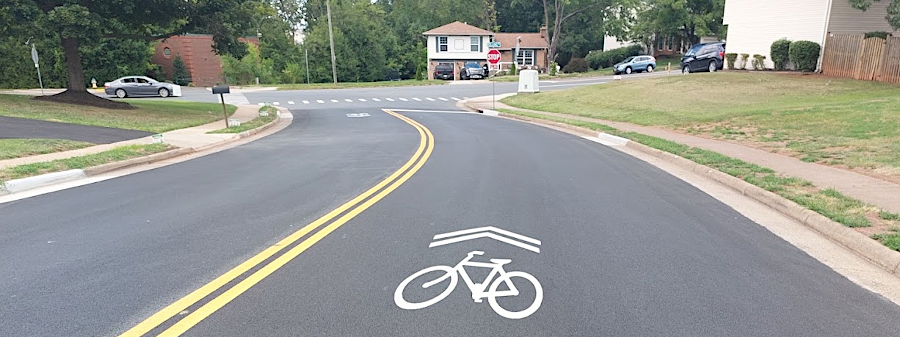
To entice the county to approve a rezoning that authorizes new development, county staff may deal with proffers for new public trails. Developers propose to provide right-of-way or even construct new trail segments. The Department of Transportation and Capital Construction, the Department of Parks and Recreation, and the Planning Office engage with the developers to identify the preferred locations for sidewalks, trails, bike paths, and on rare occasions a “shared street” with a low speed limit (see below).
Through proffers, private trails in a subdivision get linked to an expanded public trail network. The county ends up with the responsibility for managing and maintaining the new public trails, but the initial costs for land acquisition and sometimes construction are covered by the developer.
County staff gets the opportunity to endorse routes for new trails, when they are consistent with the objectives, policies and action steps in the 2040 Comprehensive Plan and Pathways 2035 to create walkable live-work-play communities.
See also: The Pathways 2035 Trails Plan Needs to Be Funded to Become “Real”